Landforms for retaining moisture, capturing sand, and sustaining livelihoods
Large scale solar energy plants, such as the Crescent Dunes Solar Energy Project in Nevada, are becoming increasingly common around the world. Yet these highly engineered infrastructures often treat their sites as tabula rasa, relying on extensive resource inputs while remaining disconnected from the surrounding landscape.
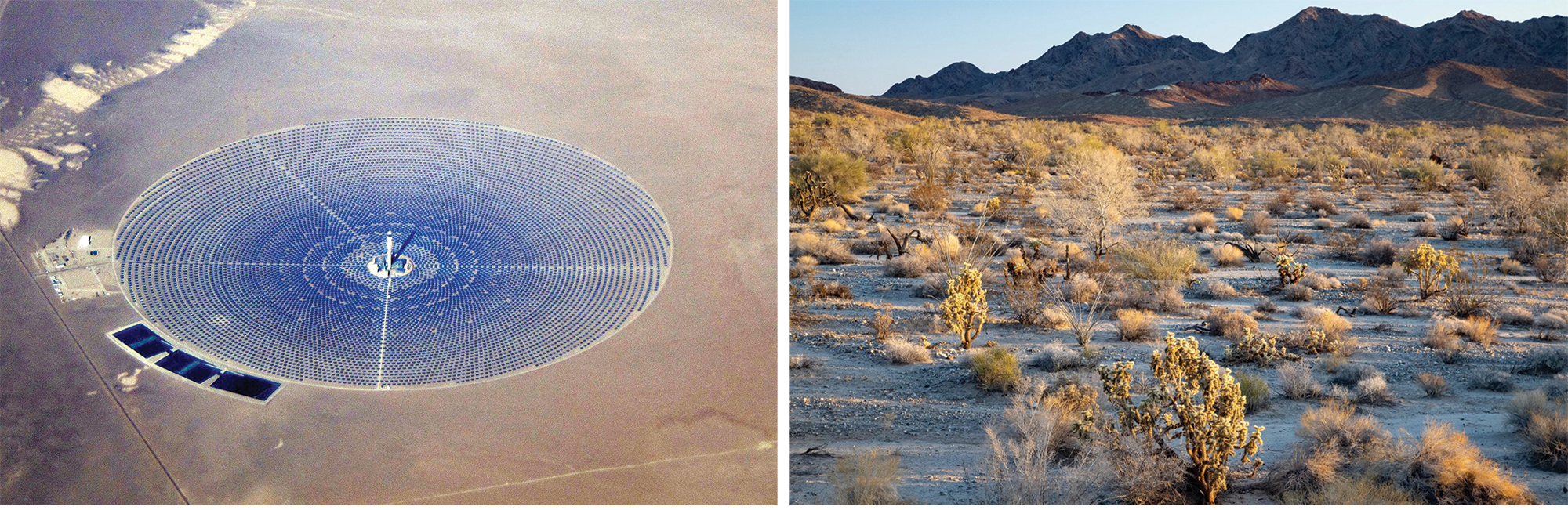 Crescent Dunes Solar Energy project as seen in air 2014 & Plants communities found in Chuckwalla Valley
This project proposes a field of Wind Bowls around the Crescent Dunes concentrating solar power plant. Rather than resisting the desert, these sculpted landforms are designed to collaborate with it. Acting as windbreaks, the bowls help protect the facility from drifting sand while remaining open to continual transformation. Over time, their forms are reshaped by wind, revealing the site’s dynamic environmental processes.
Beneath each bowl, a gravel substrate captures and retains moisture, creating favorable conditions for ecological succession. As sand gradually accumulates, pioneer vegetation can establish, transforming an otherwise barren industrial edge into a living landscape. Instead of separating infrastructure from nature, the project frames renewable energy facilities as catalysts for new ecological processes.
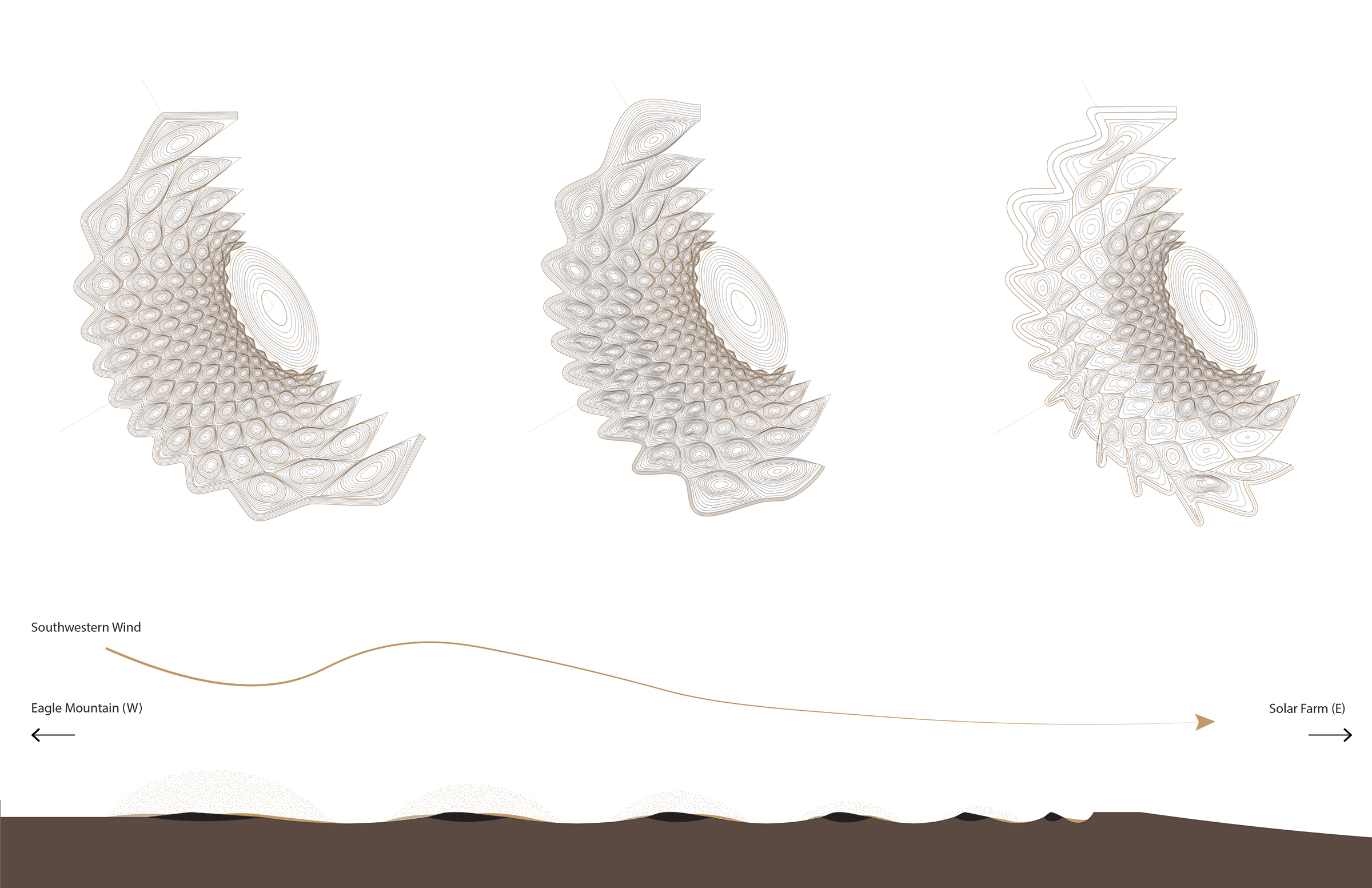 Sand accumulation and landform morphology change over time.
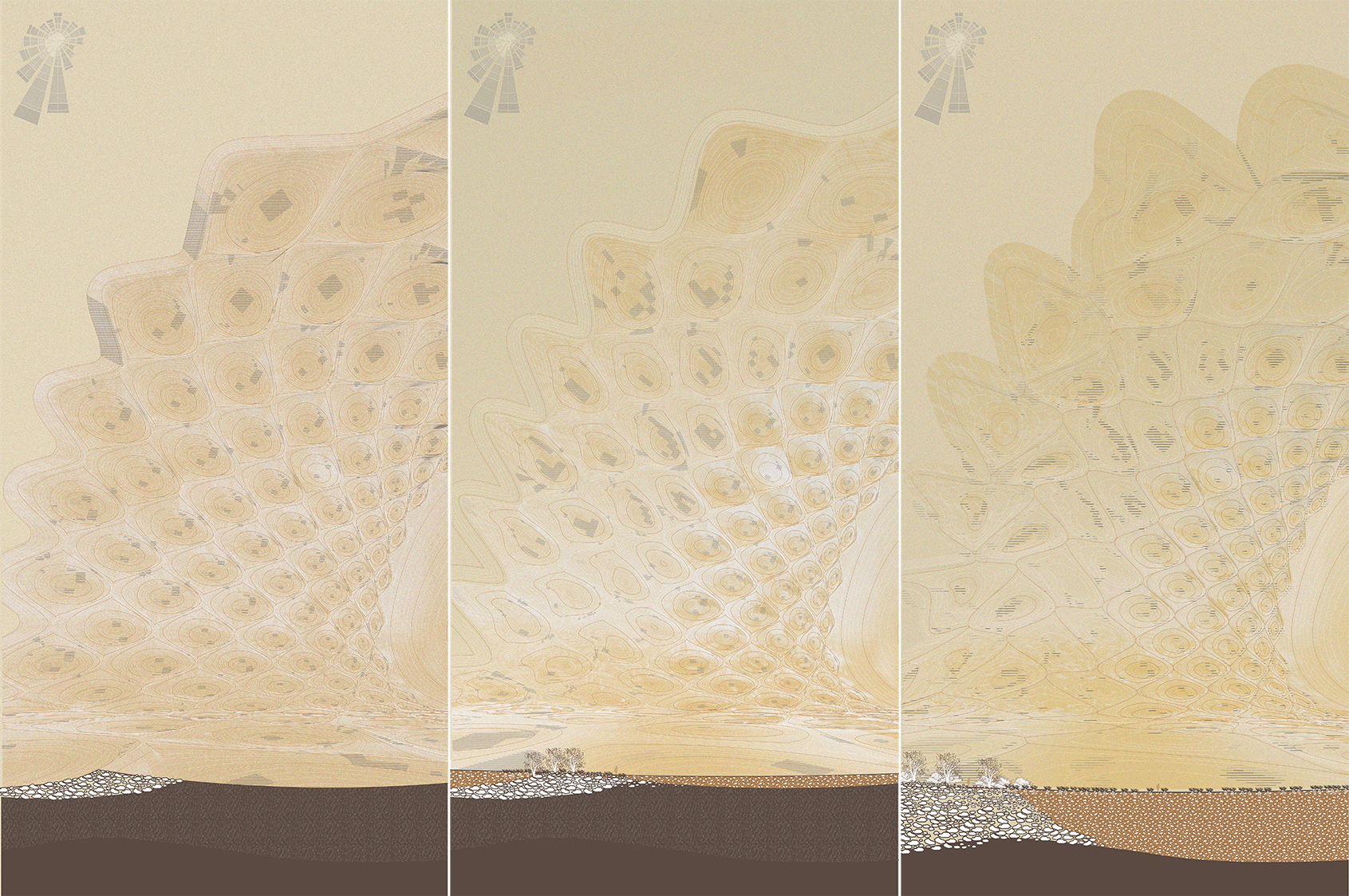 Integrated graphic representations
The drawing itself extends this idea by representing force as an active design medium. It combines plan, section, and perspective within a single continuous graphic, allowing viewers to move seamlessly across both scales and modes of understanding. The foreground presents a section illustrating the mechanism of ecological succession over time. The middle ground transitions into a perspective of a single Wind Bowl, spanning nearly 30m (100ft) in diameter and conveying the immersive scale of the landform. In the background, the drawing zooms out into a plan of the entire network of Wind Bowls, overlaid with grey hatches that identifies favorable areas for plant growth based on shade analysis. Rather than depicting a static object, the representation visualizes the interactions of wind, sand, vegetation, and topography as forces that continuously shape the landscape.
By embracing change over time and natural forces, the proposal reimagines the solar plant not as an isolated industrial object, but as the beginning of an evolving landscape. It invites natural processes to become active participants in the design, allowing life to emerge in a place otherwise considered a highly engineered no man’s land.
